MERV Rating Guide: How to Pick the Right Air Filter Without Wasting Money
MERV ratings are simple in concept and confusing in practice. This guide cuts through the marketing, the cross-walks between MERV, FPR, and MPR, and the “more is always better” myth so you can pick the right filter the first time.
A plain-English MERV guide: what each rating actually filters, when to upgrade, when to stay put, and how to match the rating to your HVAC system.
Save Money
Stop overpaying for filtration you don’t need — and avoid HVAC damage from going too aggressive.
Better Air
Match the rating to your home — pets, allergies, smoke, asthma — for cleaner air without choking your system.
Save Time
Pick the right MERV once. Stop second-guessing every filter aisle visit and every box claim.
Expert Backed
Current ASHRAE, EPA, and CDC guidance — translated from engineering specs to plain English.
MERV: The Plain-English Definition
MERV stands for Minimum Efficiency Reporting Value. It’s a 1–16 rating scale developed by ASHRAE — the engineering body that writes most of the standards your HVAC system was built to — under their test method, ASHRAE Standard 52.2.
The “minimum” part matters. MERV doesn’t measure how well a filter performs when it’s brand new and pristine. It measures the worst performance across multiple particle sizes and multiple dust loadings. That’s a deliberately conservative number. A MERV 10 filter pulls more than its rating suggests on its best day; what the rating guarantees is the floor.
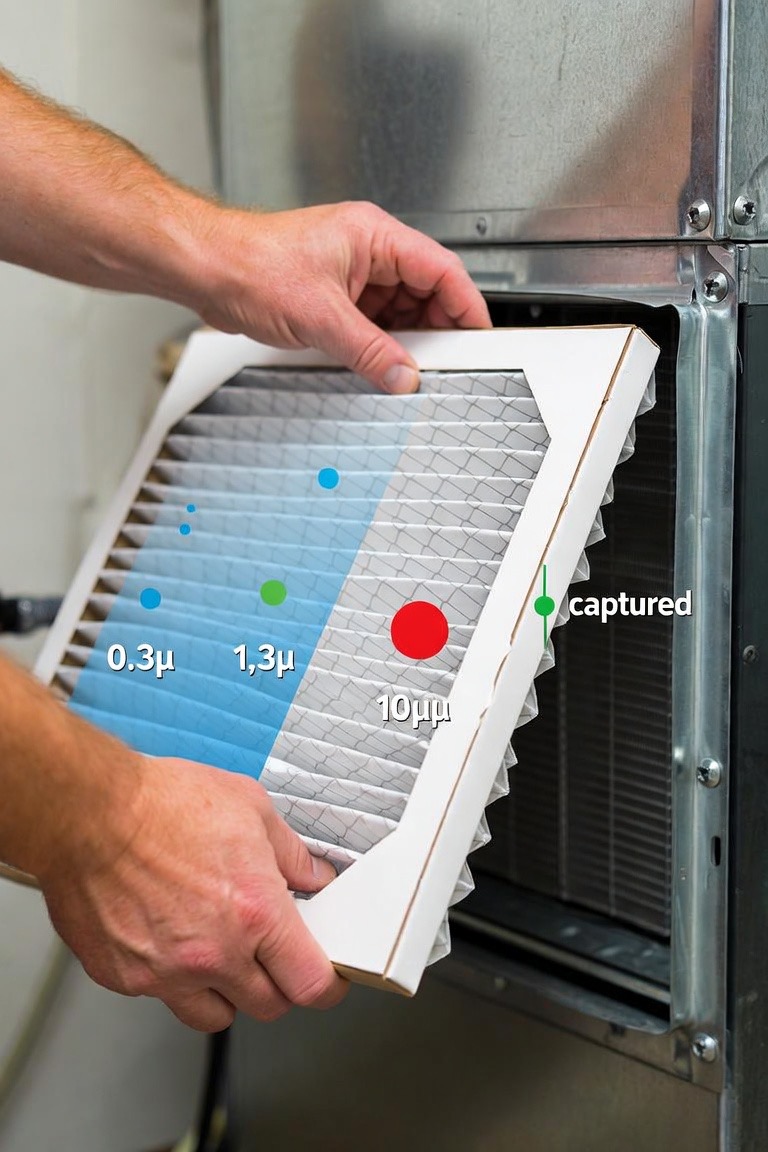
Particles are measured in microns (one micron = one millionth of a meter). For context, a human hair is about 70 microns. Pollen is 10–100 microns. Mold spores are 3–40 microns. Bacteria are around 0.3–10 microns. Smoke and viruses sit below 1 micron. ASHRAE tests filters across three particle-size ranges:
- E1 — 0.30 to 1.0 microns: bacteria, smoke, virus carriers, fine combustion particles
- E2 — 1.0 to 3.0 microns: auto emissions, mold spore fragments, fine dust
- E3 — 3.0 to 10.0 microns: pollen, dust mite debris, larger mold, pet dander
A higher MERV number means a finer filter that captures smaller particles more consistently. It also means more resistance to airflow — and that’s the catch the marketing pages skip past. We’ll come back to it.
Every MERV Rating, Plain and Visual
Here’s what each MERV rating actually captures and where it belongs. Use this as a reference, not a recommendation — the right rating for your home depends on the rest of this guide.
| MERV | Captures Down To | What It Filters | Typical Use |
|---|---|---|---|
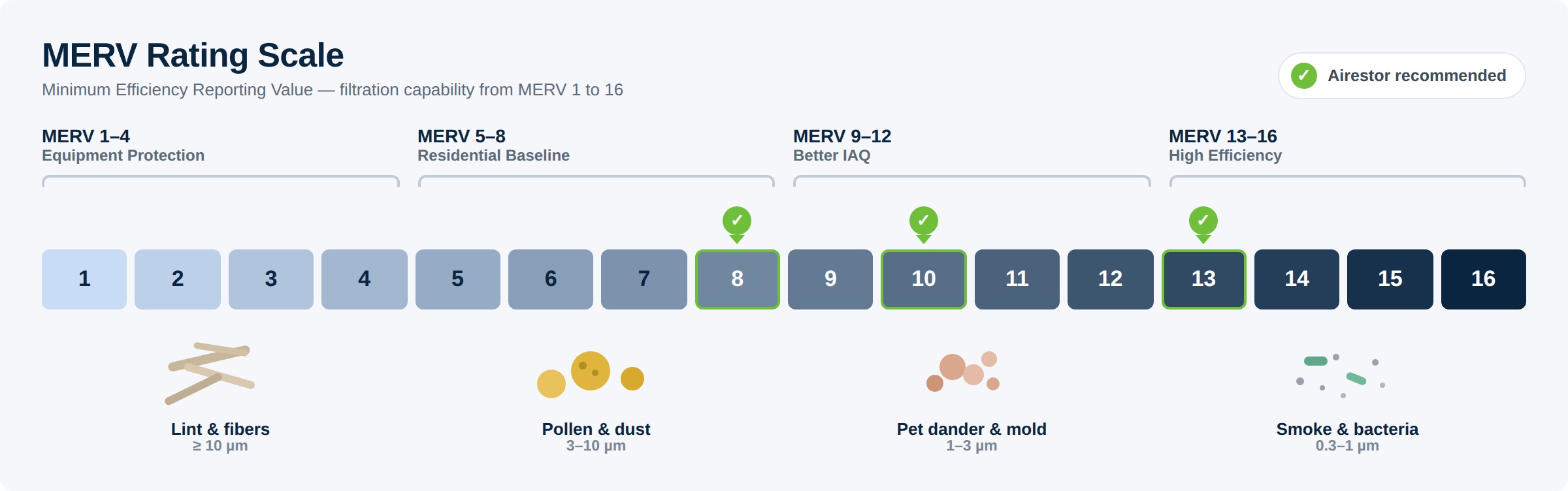
| 1–4 | > 10 microns | Lint, carpet fibers, large pollen, dust mite bodies | Window AC, minimum equipment protection |
| 5–8 | 3–10 microns | Mold spores, hair spray, cement dust, larger pet dander | Most homes’ factory default |
| 9–12 | 1–3 microns | Auto emissions, fine pet dander, milled flour, Legionella | Allergies, pets, mid-range residential |
| 13–16 | 0.3–1 microns | Bacteria, smoke, sneeze residue, virus carriers, wildfire PM2.5 | Health-sensitive homes, post-COVID standard |
| 17–20 (HEPA) | < 0.3 microns | Viruses, smallest combustion particles | Hospitals, cleanrooms — not standard HVAC |
One thing the chart doesn’t show: the jump from MERV 8 to MERV 10 is bigger in everyday terms than the jump from MERV 10 to MERV 13. MERV 10 is where dander, mold spores, and most allergens start getting reliably caught. That’s the gap most homes are trying to close.
What Each MERV Range Actually Does
MERV 1–4: Equipment Protection Only
These are the cheap, blue, see-through fiberglass panels you find at the hardware store for a couple dollars. They keep large debris out of the blower and coil. They do almost nothing for indoor air quality.
If you’re using a MERV 1–4 filter, you’re protecting the furnace, not the lungs in the house. For most homes, that’s a missed opportunity. The exception: some very old systems with weak blowers genuinely can’t push anything more restrictive, and that’s a conversation to have with an HVAC tech, not a guess to make at the hardware store.
MERV 5–8: The Residential Baseline
This is what most newer systems ship with, and it’s the floor the Department of Energy’s Zero Energy Ready Home program sets for filtration. MERV 8 catches pollen, lint, dust, larger mold spores, and most household dust. It does not catch fine pet dander, smoke, or bacterial-scale particles.
If you have no allergies, no pets, no smokers, and no special concerns, MERV 8 changed on schedule is fine. It’s not exciting. It’s not bad.
MERV 9–12: Better Indoor Air Quality
MERV 10 is the rating Airestor recommends as the default for households with pets or mild allergies. It catches fine dander, more mold, finer dust, and a meaningful share of bacterial-scale particles, while staying comfortably within the airflow most residential systems can push through a 1-inch filter slot.
MERV 12 is a small step up from MERV 10 — noticeable on the test, slight in practice. Most filter brands jump from MERV 10 to MERV 13, so MERV 12 is harder to find at retail anyway. For a deeper side-by-side, see MERV 8 vs MERV 10 vs MERV 13.
MERV 13–16: High-Efficiency Filtration
MERV 13 is where filters start capturing the particle sizes that matter for health outcomes: virus carriers, smoke, fine combustion particles, ultrafine allergens. Per the EPA’s Guide to Air Cleaners in the Home, MERV 13 (or the highest rating your system can run) is the right upgrade target if indoor air quality is a priority.
ASHRAE has gone further: post-COVID, their guidance treats MERV 13 as the minimum residential standard where infection control or air quality is a concern. CDC guidance lines up with that.
MERV 14–16 exists, but for almost every residential application it’s overkill. The airflow cost rises fast, and the marginal capture gain is small. If a household genuinely needs that level of filtration (immunocompromised resident, severe asthma, sensitive lab equipment), the right answer is usually a dedicated HEPA standalone unit, not pushing the HVAC system into territory it wasn’t built for.
MERV 17–20 (HEPA): Why You Can’t Just Drop One In
HEPA filters are rated by a different standard. A True HEPA filter captures 99.97% of particles at 0.3 microns. They live in standalone air purifiers, hospital negative-pressure rooms, and cleanrooms. They do not drop into a standard residential filter slot. The pressure drop across HEPA media is high enough that putting one in a typical home HVAC system would essentially starve the blower of airflow — frozen coils, overheated motors, no cooling.
If you want HEPA-level filtration at home, the working solution is a portable HEPA air purifier sized for the room you spend the most time in, alongside a MERV 10 or MERV 13 in the HVAC. That’s what hospitals do for non-isolation patient rooms. It’s also what the EPA recommends in their air-cleaner guidance.
ASHRAE 52.2 in Plain English
Knowing how the test works makes the rating less mysterious — and helps you spot when a manufacturer is bending the truth.
The ASHRAE 52.2 test runs a filter through 12 dust loadings. At each loading, the lab counts particles upstream and downstream across the three E1/E2/E3 size ranges. The filter has to maintain a minimum capture efficiency in each range over the entire test. The MERV number reflects the worst single result across all 12 loadings and all three particle sizes.
This is why you can’t take a marketing claim like “captures 98% of particles” at face value. The honest question is: 98% of which particle size, at which point in the filter’s life, under what airflow? MERV gives you a single defensible number that accounts for all of that. It’s why ASHRAE 52.2 is the rating system every HVAC manufacturer designs around, even when retailers run their own proprietary numbers on top of it.
Three Numbers, One Filter: The Confusion at the Filter Aisle
Walk into Home Depot and the filter box says FPR 7. Walk into Target and the Filtrete box says MPR 1500. The furnace manual says MERV 10. These are all roughly the same filter.
Here’s why there are three numbers for one rating:
- MERV is the ASHRAE industry standard. Universal, used by every HVAC manufacturer.
- FPR (Filter Performance Rating) is Home Depot’s proprietary 4–10 color-coded scale, used on filters they sell — including Honeywell and HDX.
- MPR (Microparticle Performance Rating) is 3M’s proprietary scale that runs from 100 to 2800. It was built specifically for the Filtrete line and emphasizes the sub-micron particles 3M’s media tests well on.
Neither proprietary scale is dishonest. Both are designed so that you can’t easily price-compare across stores — a “MPR 1900” sounds more impressive than “MERV 13” until you realize they describe the same filter.
MERV-to-FPR-to-MPR Cross-Walk
Use this table to translate between scales when you’re shopping. The numbers are approximate because each system tests slightly differently, but they’re close enough for filter selection.
| MERV | FPR (Home Depot) | MPR (3M Filtrete) | What It Captures |
|---|---|---|---|
| 6 | 4 | 300 | Dust, lint, large pollen |
| 8 | 5 | 600 | + Dust mite debris, mold spores |
| 10 | 6 | 800–1000 | + Fine pet dander, larger smog particles, finer mold |
| 12 | 8 | 1500 | + Bacteria carriers, finer particles |
| 13 | 10 | 1900 | + Smoke, virus carriers, sub-micron particles |
| 14–16 | — | 2200–2800 | + Fine smoke, near-HEPA territory |
The takeaway: when you’re comparing filters across stores or brands, find the MERV number on the box. It’s usually printed in small type next to the proprietary rating. That’s the number that matters.
How to Pick the Right MERV for Your System
There are two real constraints. Pick the rating that respects both.
Constraint 1: What You Need to Filter
Match the rating to the air quality outcome you actually want, not the highest number on the shelf. A house with no pets, no smokers, and no allergy sufferers doesn’t get healthier by jumping from MERV 8 to MERV 13. A house with two shedding dogs and a kid with asthma absolutely does.
Constraint 2: What Your Blower Can Push
Every furnace and air handler has a maximum total external static pressure (TESP) it’s rated for. Most residential systems are rated for 0.5 inches of water column. Your blower is fighting that pressure budget against the duct system, the coil, and the filter combined. The filter is just one chunk of the total.
Higher MERV = tighter media = more pressure drop. A 1-inch MERV 13 can add 0.10–0.15 in.w.c. of resistance at typical airflow. If your ducts are already tight (which is common in older homes and undersized returns), that extra pressure pushes the system over its design limit. Symptoms: weaker airflow at the vents, longer runtime, blower noise, frozen evaporator coils in summer, cracked heat exchangers over time in winter.
You don’t need a manometer to spot it. After you swap to a higher-MERV filter, pay attention for a week:
- Does the air at the registers feel noticeably weaker?
- Does the system run longer than usual to hit setpoint?
- Is the air handler making more noise — humming, straining, whistling at the filter slot?
- Is the temperature differential between the supply and return weaker than before?
If yes to any of those, the filter is too restrictive for the system. Drop one MERV step and the problem usually clears up.
Constraint 3 (The One Most Pages Skip): Filter Depth
This is the single biggest lever most homeowners don’t know they have. The thicker the filter, the more pleated media is folded into it, the more surface area is available, and the less pressure drop the same MERV rating creates.
| Filter Depth | Realistic MERV Range | Replacement Frequency |
|---|---|---|
| 1 inch | MERV 8–10 sweet spot; MERV 13 only on systems with headroom | Every 1–3 months |
| 2 inch | MERV 8–13 comfortably | Every 2–4 months |
| 4 inch | MERV 10–13 with low pressure drop | Every 6 months |
| 5 inch (media cabinet) | MERV 13–16 easily handled | Every 6–12 months |
If your system has a deep-pleat media cabinet (the kind that holds a 4″ or 5″ filter), you have the headroom to run MERV 13 comfortably and you’ll change the filter half as often as a 1-inch slot. If you have a 1-inch slot and want the air quality benefits of high filtration, the honest options are: stay at MERV 10, retrofit a media cabinet, or pair MERV 8 in the HVAC with a portable HEPA in the rooms that matter.
MERV Recommendations by Situation
The framework above is the answer. The cheat sheet below is the shortcut.
Standard household, no special concerns
MERV 8–10. If you have a modern system with no allergy sufferers, no pets, and no smokers, MERV 8 is fine. MERV 10 costs a couple dollars more and meaningfully improves dust pickup. Either works.
Allergies and asthma
MERV 10 minimum, MERV 13 ideal if the system can handle it. MERV 10 catches the vast majority of pollen, mold spores, and dander. MERV 13 catches the finer allergens and a chunk of smoke and bacterial-scale particles. If you’re running MERV 13 in a 1-inch slot, watch for airflow issues during the first week. For a deeper playbook on filtration timing and routines, see the allergy season HVAC guide.
Pets
MERV 10 is the default. Pet dander is mostly in the 2–10 micron range, which MERV 10 handles cleanly. You’ll also change filters more often — 30–45 days for multi-pet homes versus the standard 60–90. MERV 13 is fine but not necessary unless someone in the household is allergic to the pet. More in the pet owner air filter guide.
Wildfire smoke (Western US, including the Treasure Valley)
MERV 13 for smoke days; consider running the blower continuously. Wildfire smoke is mostly PM2.5 — particles 2.5 microns and smaller. MERV 13 catches 50%+ of those on a single pass; running the system fan continuously cycles the air through the filter every 10–15 minutes and stacks the captures. If your system can’t handle MERV 13, MERV 10 plus a portable HEPA in the bedroom is a strong fallback. Don’t open windows when AQI is in the orange or worse.
Newborns and immunocompromised households
MERV 13 in the HVAC; portable HEPA in the bedroom. This is the layered approach hospitals use. The HVAC handles the whole-home baseline; the HEPA unit handles the room where the vulnerable person spends the most time.
Older HVAC systems
Start at MERV 8, test MERV 10 carefully. Many systems from the 1990s and earlier have undersized ductwork, weak blowers, or both. They were designed around low-resistance fiberglass filters. Jumping straight to MERV 13 on these systems is the single most common cause of self-inflicted airflow problems we see. Step up gradually and watch for the symptoms above.
Apartment dwellers
MERV 8 is fine; MERV 10 if you can. Skip MERV 13 unless you control the equipment. In most apartments, you don’t know what shape the HVAC is in, how the ductwork was sized, or when the system was last serviced. Going too aggressive on the filter in a system you don’t control is a fast way to break something you can’t fix. A portable HEPA in the bedroom is the safer upgrade.
New construction or recent system replacement
MERV 13 should be your default. Equipment installed in the last 5–10 years was designed assuming the homeowner might run a higher-MERV filter. Most modern variable-speed blowers handle MERV 13 in a 1-inch slot without issue. Take advantage.
The Post-COVID Standard, Explained Honestly
Since 2020, MERV 13 has shifted from “premium upgrade” to “the recommended baseline” in most authoritative guidance. Here’s where that stands:
- EPA: Recommends upgrading to MERV 13 or the highest rating your system can handle for improved indoor air quality.
- ASHRAE: Treats MERV 13 as the minimum residential filtration standard where indoor air quality or infection control is a priority. The new ASHRAE Standard 241 — focused on infectious aerosol control in occupied buildings — codifies that for commercial settings and informs residential best practice.
- CDC: Recommends MERV 13 or higher in HVAC systems for buildings where reducing respiratory illness transmission matters.
- DOE Zero Energy Ready Home program: Requires MERV 8 minimum but encourages MERV 13 where the equipment supports it.
That convergence is significant. Five years ago, the official position was “MERV 8 is fine for most homes.” Today, it’s “MERV 13 if you can.” The shift reflects a better understanding of how airborne illness spreads, the increasing relevance of wildfire smoke as a recurring health issue across the Western US, and improvements in HVAC equipment that make MERV 13 actually runnable. For the broader picture beyond filtration, see our indoor air quality guide.
The honest caveat: “If you can” is doing a lot of work in that recommendation. Not every house can run MERV 13 in a 1-inch slot without consequences. If yours can, do it. If yours can’t, MERV 10 in the HVAC plus a portable HEPA in the bedroom outperforms a struggling MERV 13 every time.
Six Mistakes Homeowners Make with MERV
1. Buying the highest MERV the store sells
If MERV 16 sat on the shelf next to MERV 8 for the same price, most people would grab the 16. Don’t. A MERV 16 filter in a typical residential system isn’t filtering air — it’s slowly suffocating the blower. The “more is always better” reflex is the single most common filter mistake.
2. Forgetting to change the filter
A clogged MERV 13 is worse than a clean MERV 8. Pressure drop rises as the filter loads up. By the time the media is gray and dusty, the filter has stopped functioning the way it was rated and started functioning as an airflow restriction. A high-MERV filter that doesn’t get changed on schedule is the worst of both worlds — and one of the most common reasons for a higher-than-expected energy bill. See our guide on how often to change your filter for a per-system schedule.
3. Mixing up MERV, FPR, and MPR
The cross-walk above solves this once. Just find the MERV number on the box.
4. Installing the filter backwards
Pleated filters have a direction. The arrow on the frame points away from the filter, toward the blower — that’s the direction air flows through it. Installing it backwards reduces the surface area working at any given moment and accelerates clogging. Worth a 5-second check every time you swap one in — more in our air filter direction guide.
5. Ignoring filter depth as an option
Most homeowners think they’re stuck with whatever depth the filter slot is. Often you’re not. A media cabinet retrofit — a one-time install of a 4″ or 5″ deep filter housing onto the return — costs a few hundred dollars and pays for itself in three ways: better filtration, less restriction, and longer time between changes. If you’ve been wanting MERV 13 but worry about airflow, this is the move.
6. Running a high-MERV filter in a system the installer doesn’t approve of
If you have a service contract or a system under warranty, the manufacturer’s filter specification matters. Some warranties get voided by running outside the spec. Check the manual or call the installer before going past what’s recommended.
Get the Right MERV on Autopilot
The mistake most homeowners make isn’t picking the wrong MERV. It’s forgetting to change the right one on schedule. A MERV 10 filter changed every 90 days outperforms a MERV 13 filter that nobody’s looked at in eight months. Consistency beats specification.
Airestor solves that two ways. First, our filter size finder figures out exactly which size and rating your system can run — including odd sizes that the big-box stores don’t stock. Second, our auto-replenishment delivers the right filter to your door on the schedule your system actually needs, pre-labeled, no thinking required. If you manage a property, hotel, or apartment building, the same service ships pre-labeled per-unit so your maintenance team isn’t sorting filters at 7 a.m.
That’s the point: pick the right MERV once, then stop thinking about it.
MERV Rating: Common Questions
What is the best MERV rating for home use?
For most modern homes, MERV 10 is the practical sweet spot. It catches fine pet dander, mold, smog, and most allergens without putting more pressure on the blower than a 1-inch filter slot can handle. If you have allergies, asthma, wildfire smoke concerns, or a system that can support it, MERV 13 is the better target.
Is MERV 13 too much for residential HVAC?
It depends on the system. Most HVAC equipment installed in the last decade handles MERV 13 in a 1-inch slot without issue. Older systems, undersized ductwork, or weak blowers can struggle with the added resistance. If your airflow feels weaker, runtime gets longer, or the blower sounds strained after switching to MERV 13, step back to MERV 10.
What’s the difference between MERV and HEPA?
HEPA is a separate standard, not a MERV rating. True HEPA captures 99.97% of particles at 0.3 microns. The pressure drop across HEPA media is too high for typical residential HVAC blowers, which is why HEPA shows up in standalone air purifiers, hospitals, and cleanrooms — not in your furnace filter slot.
Does a higher MERV filter make my AC work harder?
Yes, slightly. A higher-MERV filter has more pressure drop across the media, which the blower has to overcome. In a system with headroom (modern variable-speed blowers, properly sized returns), the impact is minor. In an older or undersized system, the impact can be significant — including frozen coils, longer runtime, and reduced cooling capacity. A deeper filter at the same MERV rating reduces the restriction.
What MERV rating do I need for allergies?
MERV 10 minimum, MERV 13 if your system can handle it. MERV 10 catches the pollen, dander, and mold spores that drive most allergy symptoms. MERV 13 also catches finer particles like ultrafine pollen fragments and bacteria carriers. Combine either with frequent filter changes (every 30–60 days during pollen season).
What MERV rating is best for pet owners?
MERV 10 is the standard recommendation. Pet dander falls in the 2–10 micron range, which MERV 10 catches reliably. Plan to change filters every 30–45 days in multi-pet households — pet hair and dander load filters faster than dust alone.
What MERV rating catches wildfire smoke?
MERV 13 captures the majority of wildfire smoke, which is mostly PM2.5 — particles 2.5 microns and smaller. Running the system fan continuously during smoke events increases how often the air cycles through the filter and stacks the captures over time. MERV 10 helps but isn’t as effective on the finest smoke particles.
How often should I change a MERV 13 filter?
For a 1-inch MERV 13, every 30–60 days. For a 4-inch or 5-inch MERV 13 in a media cabinet, every 6 months under typical use. Higher-MERV filters trap more particles, so they load faster — replacement intervals are shorter than lower-MERV filters at the same depth.
Can I install a MERV 13 filter in an older furnace?
Sometimes, but proceed carefully. Older systems often have undersized ducts and weak blowers that were designed around low-restriction fiberglass filters. Start with MERV 10, watch for airflow symptoms for a week, then consider MERV 13 if the system handles MERV 10 cleanly. If you have any doubt, ask an HVAC tech to check static pressure before upgrading.
Do MERV ratings expire or change over the life of the filter?
The rating itself doesn’t expire, but the filter’s actual performance changes. As particles load up, the filter becomes more restrictive — pressure drop rises and airflow falls. The MERV rating reflects performance across the full test life of a clean filter; a clogged filter no longer performs at its rated efficiency or restriction. That’s why replacement schedule matters more than rating in the long run.
Is MERV 8 enough for a normal home?
For a household with no allergy sufferers, no pets, no smokers, and no special concerns, MERV 8 is genuinely fine. It satisfies the Department of Energy’s Zero Energy Ready Home minimum. The trade-up to MERV 10 is small in cost and meaningful in dust pickup, but MERV 8 is not the wrong answer for many homes.
What does FPR mean compared to MERV?
FPR (Filter Performance Rating) is Home Depot’s proprietary 4–10 scale used on filters they sell. It tracks MERV loosely: FPR 5 is about MERV 8, FPR 6 is about MERV 10, and FPR 10 is about MERV 13. MERV is the industry standard, so use the MERV number when comparing filters across stores.
What does MPR mean compared to MERV?
MPR (Microparticle Performance Rating) is 3M Filtrete’s proprietary scale, running from 100 to 2800. Rough equivalents: MPR 600 is about MERV 8, MPR 800–1000 is about MERV 10, MPR 1500 is about MERV 12, MPR 1900 is about MERV 13, and MPR 2800 is about MERV 14–16. The MPR system emphasizes sub-micron particle capture, which is where 3M’s media tests well.
Should I run my HVAC fan continuously to maximize MERV filtration?
It depends on the situation. During wildfire smoke events, allergy flares, or when someone in the household is sick, running the fan continuously cycles air through the filter every 10–15 minutes and significantly improves filtration. Day to day, continuous fan operation increases energy use modestly and can pull moisture off a wet coil into the supply air, which feels muggy. Use it as a tool, not a default.
Why is my MERV 13 filter getting dirty so fast?
That’s the filter working. Higher-MERV filters trap more particles per unit of air, so they visibly load faster than lower-MERV filters in the same home. As long as the airflow still feels normal, dirty fast is a feature. If the filter is clogged inside 30 days every time, you likely have a high particle load (construction nearby, lots of pets, smoke) or an air leak pulling unfiltered air around the filter.
Does a higher MERV filter increase my electric bill?
A small amount, yes — the blower works slightly harder against the added resistance. But a dirty, clogged filter (any MERV) increases the bill more, because the system runs longer to compensate for restricted airflow. The biggest energy lever isn’t the MERV rating; it’s whether the filter gets changed on schedule.
Can I wash and reuse a high-MERV filter?
No. Pleated MERV filters are disposable by design. The fibers that capture particles are sized and arranged for single-use. Washing them damages the media, collapses pleats, and dramatically reduces capture efficiency. Washable filters exist, but they’re almost all in the MERV 1–4 range and don’t perform like pleated filters at any MERV above 8.
What’s the highest MERV rating I can safely use in my home?
That depends on three things: your blower’s static pressure rating (usually 0.5 in.w.c. for residential), the size and condition of your ductwork and returns, and your filter slot depth. MERV 10 is safe for almost any modern system in a 1-inch slot. MERV 13 is safe for most modern systems in a 1-inch slot but worth verifying. MERV 14+ in a 1-inch slot is rarely a good idea. A media cabinet (4″ or 5″ depth) gives you more headroom across the board.
Does MERV rating affect heating performance the same way it affects cooling?
Yes — airflow restriction affects both. In heating, low airflow can cause the heat exchanger to overheat, which trips a safety limit switch. Over time, repeated overheating can crack the heat exchanger, which is a serious and expensive failure. In cooling, low airflow causes the evaporator coil to freeze. Both failure modes are downstream of the same problem: a filter too restrictive for the system.
Are there any health risks to using too low a MERV?
Indirectly, yes. MERV 1–4 filters do almost nothing for indoor air quality. Allergens, mold spores, dust, and finer particles circulate freely through the home. For households with respiratory conditions, allergies, or vulnerable members, sticking with the cheapest fiberglass filter is leaving real health benefits on the table. MERV 8 is the floor for most homes; MERV 10–13 is the upgrade most homes benefit from.
How does MERV interact with whole-house air purifiers and UV systems?
They’re complementary, not redundant. A high-MERV filter physically removes particles before air reaches the coil and the return duct. UV systems installed at the coil sanitize the coil surface and inhibit biological growth there. Whole-house air purifiers (electronic or polarized-media types) add another stage of particle capture upstream or downstream. The starting point is always a good MERV-rated mechanical filter, changed on schedule.
Does the MERV rating affect humidity in the home?
Not directly. MERV measures particle capture, not moisture. Indirectly, a restrictive filter can reduce airflow across the evaporator coil, which reduces the coil’s ability to remove humidity during cooling. So a too-aggressive MERV in a system with marginal airflow can leave the home feeling muggier than usual, even at the same thermostat setting.
Where do I find the MERV rating on my current filter?
It’s printed on the cardboard frame of the filter, usually on one of the long edges. Some manufacturers print the proprietary rating (FPR, MPR) more prominently and the MERV rating in smaller text — check both sides of the frame. If you’re holding a Filtrete box, the MERV number is often on the back of the package next to the MPR.
MERV Rating: Myth vs Fact
- Myth: A higher MERV always means cleaner air at home.
- Fact: Higher MERV captures more particles per pass, but only if your blower can push enough air through the filter. A MERV 16 starving a 1990s blower delivers worse real-world filtration than a clean MERV 10 with proper airflow. The right MERV is the highest one your system can run consistently, not the highest one the store carries.
- Myth: MERV 13 protects you from viruses.
- Fact: MERV 13 captures a meaningful share of virus-carrying droplets — the larger respiratory aerosols that transport viruses around. Free virus particles themselves (~0.1 microns) are below MERV 13’s reliable capture range. MERV 13 is a strong layer in a defense, not a force field. Pair it with ventilation and, where it matters, a HEPA standalone unit.
- Myth: Washable filters are as good as pleated MERV filters.
- Fact: Almost all washable / “lifetime” filters are MERV 1–4 equivalent. They protect equipment from large debris but do little for indoor air quality. They also lose efficiency between washes as the media degrades. If you want filtration, use a pleated MERV-rated filter and replace it on schedule.
- Myth: A new filter looking dirty within a month means it’s defective.
- Fact: A higher-MERV filter looking loaded faster than your old filter is usually the filter doing its job. If airflow still feels normal, the dirt is the point. If airflow is noticeably weaker, then yes — either the filter is too restrictive for your system, or unfiltered air is leaking around the filter frame.
- Myth: Once you pick a MERV rating, you’re locked in for the life of the system.
- Fact: You can step up or down between filter changes with no consequence. Many homeowners run MERV 13 during pollen season and wildfire smoke season, then drop back to MERV 10 the rest of the year to give the blower a break. The filter is the easiest thing in your HVAC system to experiment with.
- Myth: Brand-name filters always outperform store-brand at the same MERV.
- Fact: ASHRAE 52.2 is the same test regardless of brand. A MERV 10 from a generic manufacturer hits the same minimum performance floor as a MERV 10 from a brand-name. Differences in pleat density, frame construction, and consistency exist, but they don’t change the MERV rating itself.
