The Pet Owner’s Air Filter Guide: MERV, Schedules, and the Allergen Behind the Sneeze
Dander, hair, odor, the kid with sniffles — pet households put real load on the HVAC. This guide cuts through the marketing and shows what filter, what schedule, and what supporting moves actually keep the air clean.
A plain-English playbook for dog, cat, bird, and small-mammal owners: what to buy, how often to change it, and what filtration can’t fix on its own.
Less Dander
Catch the airborne allergens your pet sheds before they reach lungs and upholstery.
Fresh Air
Plain-English MERV and odor guidance — without the “always go highest” marketing.
Save Money
Avoid choking your blower with a too-restrictive filter. Pick the right one once.
Honest Advice
From real pet households — combining filtration, source control, and HEPA where it counts.
1 Why Pets Are Different
Pet Homes Put Real Load on the HVAC
Pets don’t just shed hair you can see on the couch. They shed a continuous, invisible cloud of dander (microscopic flakes of skin), saliva proteins, urine proteins, and dust their fur tracks in from outside. All of that ends up in your return air and packed into your filter.
The American Veterinary Medical Association estimates roughly 45% of U.S. households own a dog and 26% own a cat, with millions more keeping birds, rabbits, ferrets, hamsters, guinea pigs, and reptiles. Most of those homes are running the same factory-default MERV 8 filter the builder installed, on the same 90-day replacement schedule the box prescribes. That math doesn’t work for a pet household.
Here’s what changes when an animal lives in your home:
- Filter loading rates double or triple. A 1-inch pleated filter that lasts 90 days in a pet-free home often clogs in 30–45 days when there’s a dog or cat in the house.
- Allergens enter the supply air on every cycle. The HVAC pulls dander-laden return air, the filter catches some of it, and the rest gets re-delivered around the home through the supply ducts.
- Odor molecules pass straight through a standard particle filter. MERV doesn’t measure gas-phase capture. We’ll come back to this in section 7.
- The blower works harder. A loaded filter creates more pressure drop, so the system runs longer to hit the same setpoint. That’s extra energy use and extra wear before you notice anything is wrong.
The goal of this guide is the same goal a good HVAC tech would have: get the right filter, on the right schedule, paired with the right supporting moves. Not the most expensive option on the shelf. The right one for an actual pet household.
2 Allergens
The Allergen Behind the Sneeze: It’s Not the Hair
This is the single most useful thing to understand before picking a filter. Most pet owners assume the hair is the problem. It isn’t — not directly.
The thing that actually drives allergy and asthma symptoms is dander and the proteins that ride along with it. According to the American Lung Association and the National Institute of Environmental Health Sciences, the primary pet allergens are:
- Fel d 1 — the dominant cat allergen, produced in saliva and sebaceous glands and spread to fur during grooming
- Can f 1 and Can f 2 — the dominant dog allergens, from saliva, skin glands, and urine
- Bird feather dust and droppings dust — feather-keratin particles plus dried droppings dust
- Rodent urine proteins — primary allergens for mice, rats, hamsters, guinea pigs
These allergens cling to tiny skin flakes (dander) that are 2–10 microns across. For context, a human hair is about 70 microns. So pet allergens are roughly seven to thirty times smaller than a strand of human hair. They float in the air for hours, cling to soft surfaces, and circulate through every cooling and heating cycle.
The pet hair itself is mostly a vehicle: it traps dander and lifts it into the air when the pet moves, when you sit on the couch, or when the HVAC fan kicks on. Capturing the hair matters because of what’s stuck to it, not because the hair itself is the allergen.
Two practical takeaways:
- A filter that only catches large particles (MERV 1–6) catches the hair and lets the dander pass right through — which is the worst outcome for an allergy household.
- A filter rated to capture down into the 2–3 micron range (MERV 10 or higher) catches the dander itself, not just the hair carrying it.
That’s the whole game. The chart below makes the math visual — pet dander sits right at the threshold where MERV 10 starts catching reliably, with MERV 13 reaching deeper into the bacteria range.
What’s Floating in Your Air — and What Your Filter Catches
Particle sizes on a logarithmic micron (µm) scale. The smaller the particle, the harder it is to trap. See how MERV 10 and MERV 13 capture ranges stack up against the four particle types in a pet home.
MERV 13 Captures down to 0.3 µm — traps bacteria, the fine end of pet dander, and most wildfire smoke (PM2.5).
MERV 10 Captures down to 1.0 µm — reliably catches pet dander and pollen; misses the very smallest particles.
3 MERV Rating
What MERV Rating Pet Owners Should Actually Buy
If you only read one section of this page, this is the one. The headline:
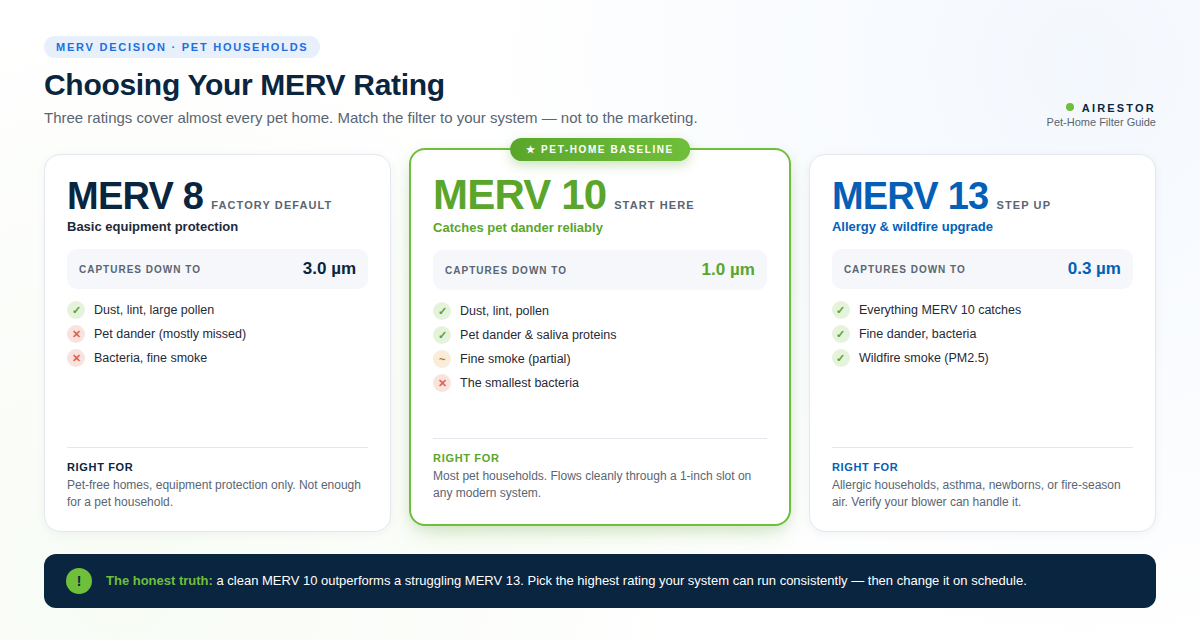
MERV 10 is the right baseline for almost every pet household. MERV 13 is the upgrade target if someone in the home is allergic and your system can support it.
Here’s why — and where the standard internet advice gets it wrong.
Why MERV 10 is the pet-home default
Pet dander sits in the 2–10 micron range. MERV 10 is the rating where filters start reliably capturing particles down to 1–3 microns, which fully covers the dander range with margin to spare. The jump from MERV 8 to MERV 10 is the single biggest real-world improvement you can make for a pet home — bigger than the jump from MERV 10 to MERV 13 in everyday terms.
Equally important: MERV 10 stays comfortably within the airflow most residential systems can handle in a 1-inch filter slot. Your blower isn’t fighting the filter the way it would with a high-MERV filter that’s too restrictive for the equipment. The full MERV rating guide walks through how filter depth and blower static pressure interact — worth a read if you’re shopping for the first time.
When MERV 13 is worth the upgrade
- Someone in the household has a confirmed pet allergy. The finer capture matters here. Per the EPA’s Guide to Air Cleaners in the Home, MERV 13 is the recommended target where indoor air quality is a priority.
- Someone has asthma or a respiratory condition made worse by airborne particles.
- You have a newborn, an elderly resident, or an immunocompromised household member.
- You live in a wildfire-prone region like the Western US. (More on the Idaho / Treasure Valley angle below.)
- Your equipment was installed in the last decade and supports MERV 13 without airflow symptoms.
When MERV 13 backfires
MERV 13 has a higher pressure drop than MERV 10. On modern systems with variable-speed blowers and adequate ductwork, that’s a non-issue. On older systems, undersized returns, or marginal blowers, it can cause:
- Weaker airflow at the registers
- Longer runtimes to hit setpoint
- Frozen evaporator coils in summer
- Cracked heat exchangers in winter (a serious safety issue)
- Blower noise and strain
If you switch from MERV 8 or 10 to MERV 13 and notice any of those symptoms within the first week, drop back a step. The honest reality — missed by most product pages — is that a clean MERV 10 outperforms a struggling MERV 13 in real-world conditions.
Why Airestor recommends MERV 10 as the default
Airestor stocks MERV 8, MERV 10, and MERV 13 because those three cover the meaningful decision points for almost every home: equipment protection (8), pet-and-allergen baseline (10), and health-priority upgrade (13). MERV 10 is the rating where dander, fine pet hair, and most household allergens start getting reliably caught — the threshold most pet homes need to clear — while still flowing cleanly through a typical 1-inch filter slot. It’s the right place to start a pet-home filtration plan.
The Treasure Valley angle
If you’re reading this from Boise, Meridian, Nampa, Caldwell, or anywhere in the broader Idaho region, your filter has a second job during fire season: catching wildfire smoke on top of pet dander. PM2.5 from smoke is finer than dander — particles 2.5 microns and smaller — and MERV 13 captures it meaningfully better than MERV 10 does. A reasonable Treasure Valley pet-home pattern is to run MERV 10 most of the year and swap to MERV 13 during smoke events and high-pollen weeks, then drop back. The filter is the easiest thing in your HVAC to experiment with.
4 Replacement Schedule
How Often to Change Your Filter When You Have Pets
The replacement interval printed on the filter box assumes a household with no pets. If you have one or more animals in the home, cut that schedule meaningfully — not because the box is lying, but because pet dander and hair load filters faster than dust alone.
Here’s a realistic schedule by household:
| Household | 1–Inch Filter | 2–Inch Filter | 4–Inch Media Cabinet |
|---|---|---|---|
| No pets (reference) | 60–90 days | 3–4 months | 6–12 months |
| 1 pet, low-shed (poodle, sphynx, etc.) | 45–60 days | 2–3 months | 5–8 months |
| 1 pet, average shed (typical dog or cat) | 45 days | 2 months | 4–6 months |
| 2–3 pets | 30–45 days | 6–8 weeks | 3–5 months |
| Heavy shedders (Husky, GSD, Persian, etc.) | 30 days | 6 weeks | 3–4 months |
| Multi-pet + allergy sufferer | 30 days | 4–6 weeks | 3 months |
A few practical notes:
- Look, don’t rely on the calendar. Pull the filter monthly. If it’s visibly gray and you can’t see light through it when you hold it up, change it. The calendar is a planning tool; the eye test is the real one.
- Higher MERV loads faster. A MERV 13 in a 1-inch slot in a multi-pet home can clog in 3–4 weeks. That’s the filter doing its job, not a defect.
- Deeper filters last meaningfully longer. If you have a 4-inch or 5-inch media cabinet, you have more surface area and you change the filter half as often.
- Shedding season matters. Spring shed (April–May) and fall coat-blow (September–October) load filters faster. Pull more often during those windows.
- Forgetting is the real failure mode. A clogged MERV 10 ten weeks past due performs worse than a clean MERV 8. The schedule beats the rating in the long run. Our deeper filter replacement frequency guide covers the full math.
5 By Pet Type
By Pet: Dogs, Cats, Birds, Small Mammals, and Reptiles
Different animals shed different things at different rates. Your filter strategy should follow.
Dogs
Dogs are the highest-load pet for HVAC filtration. Their dander particles tend to sit in the larger end of the 2–10 micron range, which MERV 10 catches reliably. Their hair is highly variable by breed — a Husky in coat-blow will load a filter ten times faster than a Vizsla.
Filter: MERV 10 baseline; MERV 13 if anyone is allergic.
Schedule: 45 days for one average-shed dog; 30 days for two or more, or for heavy shedders.
Higher-load breeds: Husky, German Shepherd, Golden Retriever, Labrador, Saint Bernard, Newfoundland, Akita, Malamute, Australian Shepherd, Border Collie, Samoyed, Chow Chow.
Lower-load breeds: Poodle, Bichon Frise, Maltese, Yorkshire Terrier, Schnauzer, Portuguese Water Dog, Labradoodle, Goldendoodle. (“Hypoallergenic” is a marketing term — these breeds still produce dander and Can f 1; they just shed less hair.)
Cats
The Fel d 1 protein cats produce is one of the most potent residential allergens known. Cat dander particles are smaller than dog dander — closer to 2–5 microns — and stay airborne longer. They also stick to fabric and walls in a way dog dander doesn’t, which means even a year after a cat is gone, the allergen can still circulate.
Filter: MERV 10 baseline; MERV 13 strongly considered if anyone is allergic, especially with two or more cats.
Schedule: 45–60 days for one cat; 30–45 days for two or more.
Higher-load breeds: Persian, Maine Coon, Norwegian Forest Cat, Ragdoll, Siberian.
Note: Siberians and Balinese are sometimes marketed as “low-allergen” because they produce less Fel d 1 — not zero. Anyone with a confirmed cat allergy should still plan on MERV 13 plus a bedroom HEPA.
Birds
Bird owners face an under-discussed filtration challenge. Many species — African Greys, Cockatoos, Cockatiels, Amazons — produce powder down, an extremely fine keratin dust used to waterproof feathers. Powder-down particles are smaller than typical mammal dander and become airborne with every wing flap or preening session. Add dried droppings dust and seed-husk debris, and a single bird in a home can load filters as fast as a heavy-shedding dog.
Filter: MERV 10 minimum; MERV 13 strongly recommended for powder-down species. Run the system fan continuously when the bird is uncovered.
Schedule: 30–45 days for most birds; 30 days for powder-down species or multi-bird homes.
Strong recommendation: A standalone HEPA air purifier in the bird’s room. The whole-house filter handles the home; the standalone handles the source.
Small mammals (rabbits, guinea pigs, hamsters, rats, mice, ferrets)
Small mammals are lower-load on the HVAC overall because they live in enclosures, but two specific issues matter. First, their urine proteins are potent allergens — mouse and rat allergens are major causes of indoor allergic disease. Second, bedding dust (especially pine, cedar, and lower-grade paper bedding) generates fine respirable particles that the HVAC will recirculate.
Filter: MERV 10 baseline; MERV 13 if anyone in the household is allergic to the species.
Schedule: 45–60 days, depending on number of animals and bedding type.
Source moves: Switch to dust-extracted paper or aspen bedding; keep enclosures away from HVAC returns; clean weekly.
Reptiles and amphibians
Reptiles and amphibians produce almost no airborne allergens themselves and don’t affect the HVAC filter much. The exception is substrate dust — coconut fiber, cypress mulch, and certain sand substrates can throw fine dust during cage cleaning that gets pulled into the return.
Filter: Standard household recommendation (MERV 8–10 baseline depending on other factors).
Schedule: Standard residential schedule; no significant pet-driven acceleration.
6 Household Profiles
Single Pet vs Multi-Pet vs Heavy Shedders
Two homes with the same square footage can put wildly different loads on the HVAC depending on what’s living in them. Use this as a quick household profile read:
One average-shed pet, no allergies
MERV 10 in a 1-inch slot, replaced every 45 days. Vacuum twice a week with a HEPA-bag vacuum. Brush the pet weekly outside or in the garage. That’s the whole program. You don’t need MERV 13 or a HEPA standalone unless something changes.
One pet, mild seasonal allergies
MERV 10 most of the year, MERV 13 during the symptom-flare months (spring shed, ragweed season). Add a portable HEPA in the bedroom during flare windows. Brush the pet daily during shedding seasons. Don’t let the pet sleep on the bed during flare-up periods if you can avoid it.
Two or three pets, no allergies
MERV 10 in a 1-inch slot, replaced every 30–45 days. Consider a media cabinet retrofit (4-inch deep) if you’re tired of changing 1-inch filters monthly — same MERV rating, half the changes, less restriction, better airflow. Vacuum 2–3 times a week.
Two or more pets plus an allergy sufferer
MERV 13 in the HVAC (assuming your system can run it), portable HEPA in the allergic person’s bedroom running 24/7, 30-day filter changes. Confine pets out of the bedroom. Wash bedding weekly in hot water. This is the layered hospital approach scaled to a home.
Heavy-shedding breed, single pet
Treat as “multi-pet” for filter math. A single Husky, Golden, Newfoundland, or Persian throws as much hair and dander as two average-shed pets. MERV 10 minimum, 30-day changes during coat-blow seasons (spring, fall).
New puppy or kitten
Adolescent pets shed less than mature ones for the first 6–12 months. You can run the standard pet schedule, but expect filter loading to increase noticeably as the animal matures. If you’re a first-time pet owner who hasn’t adjusted your filter routine yet, this is the moment.
Allergy household considering a pet
The honest advice: if anyone in the home has a confirmed allergy to the species, no filter strategy fully eliminates the exposure. MERV 13 plus a bedroom HEPA plus rigorous source control reduces symptoms, often substantially, but it doesn’t make the home equivalent to a pet-free home. Talk to an allergist about immunotherapy before making the decision.
7 Pet Odor
The Honest Truth About Pet Odor
This is the topic where most filter marketing gets the most dishonest. Here’s the unvarnished version.
MERV ratings don’t measure odor. MERV is a particle test. It rates how well a filter captures solid particles across three size ranges (0.3–1, 1–3, and 3–10 microns). Odor — including dog smell, cat box ammonia, ferret musk, bird droppings — isn’t a particle problem. It’s a gas-phase problem: volatile organic compounds (VOCs), ammonia, hydrogen sulfide, mercaptans, and a soup of other small molecules that pass straight through a particle filter, no matter how high the MERV rating.
That means a MERV 13 filter, by itself, will not fix a smelly house. Anyone selling you one on the promise that it will is misleading you.
What actually addresses pet odor
- Activated carbon (charcoal). Carbon adsorbs gas-phase molecules onto its surface. Some pet-marketed filters add a layer of carbon to a pleated MERV filter (e.g., “MERV 10 + carbon”). This does reduce odor, but the carbon layer in a 1-inch filter is thin and saturates quickly — usually within 30–60 days. It helps; it doesn’t solve.
- Standalone carbon air purifiers. Units with serious carbon mass (1–5 lbs of carbon, not the token amount in cheap purifiers) make a real dent in odor. Place them near the source — litter box room, pet bed, bird cage.
- Litter management. The single biggest cat-odor lever isn’t any filter; it’s scooping daily and replacing litter weekly. Covered boxes trap odor inside; uncovered boxes release it but make scooping more obvious.
- Bedding and washing. Pet beds, throw blankets, and the spot on the couch they sleep on hold odor compounds. Weekly washing matters more than any filter upgrade.
- Ventilation. Opening windows for 15–30 minutes a day cycles out odor-laden air. (Skip this during wildfire smoke or high pollen.)
- Dental care for dogs. A surprising amount of “dog smell” is dental disease releasing sulfur compounds. If your dog is older and starting to smell more, ask your vet about a cleaning.
Bottom line: if odor is your primary concern, the filter is part of the answer but not the answer. A pleated MERV 10 plus a carbon-treated filter plus weekly source-control habits will do far more than the highest-MERV filter alone.
8 Allergic Households
Pet Allergies in the Household: When to Layer HEPA
If someone in your home has a clinically diagnosed pet allergy or asthma, filtration becomes meaningful health infrastructure, not a comfort upgrade. The right approach is layered:
Layer 1: MERV 13 in the HVAC (if your system supports it)
This is the whole-home baseline. Every time the HVAC runs, the air pulls through the filter and dander gets stripped out. Per the EPA’s recommendations covered in the MERV guide, MERV 13 is the residential standard where indoor air quality is a priority. The trade-off: more airflow restriction, which not every system handles. Watch for the symptoms in section 3 during the first week after upgrading.
If your system can’t run MERV 13 cleanly, the fallback is MERV 10 in the HVAC plus a more aggressive standalone HEPA setup in the rooms that matter.
Layer 2: Portable HEPA in the bedroom
The bedroom is where the allergic person spends 7–9 hours a day, lying motionless, breathing slowly, with their head 18 inches from bedding that’s been collecting dander. Air quality in this single room matters more than air quality anywhere else in the house.
A portable HEPA air purifier sized for the room (look for a CADR rating that matches your square footage) running on medium speed 24/7 will cycle the bedroom air every 15–30 minutes and drop airborne allergen counts dramatically. This is the same approach hospitals use for non-isolation patient rooms.
Layer 3: Run the HVAC fan more aggressively
By default, your HVAC fan only runs when the system is heating or cooling. In an allergy household, switching the fan to “On” instead of “Auto” — or programming intermittent fan cycles — runs more air through the filter, more often. Modern variable-speed blowers do this efficiently. The energy cost is modest; the allergen reduction is significant.
Layer 4: Source control
This is the layer everyone wants to skip. It’s also the layer with the highest return.
- Confine the pet out of the bedroom. Hardest moral call, biggest single allergy reduction.
- Brush the pet daily outside during shedding seasons (March–May, September–October).
- Bathe dogs weekly in pet-safe shampoo. Studies in the Journal of Allergy and Clinical Immunology have shown weekly bathing meaningfully reduces airborne Can f 1.
- Wipe cats with damp microfiber cloths if you can’t bathe them. Even partial reduction of saliva proteins on the coat helps.
- HEPA-bag vacuum at least twice a week on carpets, upholstery, and any area the pet frequents.
- Wash all bedding — human and pet — weekly in hot water (130°F+).
- Hard floors beat carpet in allergy households. Carpet acts as a dander reservoir; tile, hardwood, and laminate let you clean dander out of the room.
When to see an allergist
If symptoms persist despite the layered approach, the next move is medical, not mechanical. Allergy immunotherapy (allergy shots or sublingual drops) can desensitize an allergic person over 3–5 years and is the only intervention proven to alter the underlying allergic response. Talk to an allergist; the EPA and CDC both note that environmental controls work best when combined with appropriate medical treatment.
9 Source Control
What Filters Can’t Fix: Source Control for Pet Homes
A filter is a downstream solution. It captures what’s already in the air. The cheapest indoor air quality move in a pet household is reducing how much dander, hair, and odor enters the air in the first place.
The high-leverage moves, in roughly the order of return on time invested:
Weekly grooming
Brushing a shedding dog or cat for 10 minutes a week, outside, removes hair before it migrates to the couch, the carpet, and the return duct. For heavy-shedding breeds, brushing daily during coat-blow seasons (spring and fall) makes a visible difference in filter loading inside two weeks.
Vacuuming with a HEPA-bag machine
A regular bagless vacuum redistributes fine particles back into the air through the exhaust. A HEPA-filter vacuum captures and contains them. Twice a week is the floor for a pet home; three or four times a week is better if you have allergies. Pay extra attention to upholstery, drapes, and area rugs.
Hard floors over carpet
Carpet is a dander reservoir. Every time someone walks across it, it releases a cloud of allergens into the air. Tile, sealed concrete, hardwood, and laminate all give you a surface you can actually clean clean. If you’re replacing flooring anyway and have allergy concerns, take the cue.
Damp dusting, not dry dusting
Dry-dusting redistributes dander. A microfiber cloth lightly dampened with water actually picks it up. Same for floors — mop, don’t broom.
HEPA-filter robot vacuums
Daily runs of a HEPA-filtered robot vacuum maintain a baseline you can’t hit manually. It’s not a replacement for a deep weekly clean, but as a daily floor-level allergen sweep it’s remarkable how much dander it pulls out before it has a chance to circulate.
Wash pet bedding weekly
Pet beds are dander concentrators. Weekly washing in hot water (130°F+) kills dust mites and removes accumulated saliva proteins. If the bed isn’t machine-washable, replace it with one that is.
Manage the litter box
Daily scooping. Weekly litter replacement. Low-dust litter (avoid clay clumping litters that throw fine respirable dust). Consider a high-sided or hooded box to keep litter dust from spreading.
Air sealing the home
This one’s indirect but real: a leaky home pulls unfiltered outdoor air around your filter, including pollen, smoke, and outdoor dust that loads filters and stresses allergic occupants. Air-sealing the attic and basement is one of the highest-ROI energy upgrades you can make, and it incidentally improves filter performance.
Filters and source control aren’t alternatives — they multiply each other. A MERV 10 in a home with good source control will outperform a MERV 13 in a home where the pet has free run of the bedroom and nobody’s vacuumed in a month.
Airestor
The Right Filter, Pre-Labeled, on the Schedule a Pet Home Actually Needs.
Pet households need filters more often than the standard 90-day cycle. Forgetting the change is the most common failure mode — and the one that turns a working MERV 10 into an airflow restriction.
Airestor delivers the right filter for your system, in the right size, on the schedule a pet home actually needs — pre-labeled, no thinking required. Custom sizes available. Honest sizing help. No hardware-store guessing.
10 Mistakes
Six Mistakes Pet Owners Make With Air Filters
1. Sticking with the factory MERV 8 forever
The MERV 8 the builder installed is fine for a pet-free household. It catches hair and large particles, lets fine dander pass through. If you’ve owned the home longer than the first filter and you have pets, you’ve probably outgrown it.
2. Jumping straight to MERV 13 in an old system
The opposite mistake. Older systems with undersized returns and weaker blowers were designed around low-restriction filters. Dropping in a MERV 13 in a 1-inch slot on a 1990s system is the fastest way to freeze a coil or crack a heat exchanger. Step up gradually — MERV 8, then MERV 10, watch for airflow symptoms, then consider MERV 13 if everything still feels normal.
3. Buying a “washable” or “permanent” filter
Almost every washable filter on the market is MERV 1–4 equivalent. They catch hair and large debris. They do basically nothing for pet dander. The marketing about “saving money on replacements” ignores the fact that the filter doing nothing for dander is also doing nothing for the people allergic to it.
4. Forgetting the schedule, then doubling up
A clogged MERV 10 four months in is worse than a clean MERV 8. Pressure drop rises as the filter loads; airflow falls; the system runs longer to compensate; eventually the coil freezes or the blower strains. Doubling up on filters (stacking one behind another) makes the problem worse, not better. One clean filter, replaced on schedule, is the right answer.
5. Treating pet odor as a filter problem
It isn’t. Particles and gases are different problems. A carbon-treated filter helps; it doesn’t replace source control. If your house smells, the answer is litter management, bedding washing, ventilation, and possibly a standalone carbon purifier — not a higher MERV number.
6. Believing “hypoallergenic” eliminates the need for filtration
No dog or cat breed is fully hypoallergenic. Low-shed breeds still produce Can f 1 (dogs) and Fel d 1 (cats); they just put less hair in the air. Owners of poodles, doodles, Sphynxes, and Siberians sometimes skip the filtration upgrade thinking the breed handles it — then wonder why a guest with a confirmed allergy still reacts. The proteins are still there.
11 Autopilot
Get the Right Filter on the Right Schedule, Automatically
The single biggest failure mode in pet households isn’t picking the wrong filter — it’s forgetting to replace the right one on time. A MERV 10 changed every 45 days outperforms a MERV 13 nobody’s looked at in six months. Consistency beats specification.
That’s why Airestor exists. Two parts to the answer:
- Honest sizing help. Our filter size finder identifies your exact filter size and the right MERV rating for your system — including the odd sizes that big-box stores don’t stock. Custom sizes are available if your slot doesn’t match a standard.
- Auto-replenishment on a pet-home schedule. 30, 45, or 60 days — you pick. The right filter shows up at your door before the current one needs swapping. Pre-labeled if you manage multiple units or run a household with multiple HVAC zones.
For property managers running multifamily buildings with pet-friendly units, the same service ships pre-labeled per-unit so maintenance teams aren’t sorting filters at 7 a.m. on a Tuesday.
The point is the same as it’s always been: pick the right MERV once, then stop thinking about it.
12 FAQ
Pet Owner Air Filter: Common Questions
What is the best MERV rating for pet owners?
MERV 10 is the right baseline for most pet households. It catches pet dander (2–10 microns) reliably without restricting airflow in a typical residential blower. Step up to MERV 13 if someone in the home is allergic to the pet and your system can handle the added pressure drop. Avoid MERV 1–6 in pet homes — those filters catch the hair but let the dander pass through, which is the worst combination for allergy households.
How often should I change my air filter if I have pets?
Plan on 45 days for a 1-inch filter with one average-shed pet, 30–45 days for two or more pets, and 30 days flat for heavy shedders or households with allergies. The pet-free baseline of 60–90 days doesn’t apply — pet dander and hair load filters two to three times faster than dust alone. Visual checks monthly are the real signal: if you can’t see light through the filter, it’s done.
Do air filters help with pet allergies?
Yes, meaningfully — but only if you pick the right rating. The filter has to catch the dander particles, not just the hair. MERV 10 catches the bulk of pet dander; MERV 13 catches more of the finer allergens. For allergy sufferers, layer a portable HEPA in the bedroom on top of a MERV 10 or 13 in the HVAC. The HVAC handles the whole-home baseline; the HEPA handles the room where the allergic person spends the most time.
Can an HVAC filter remove pet odor?
A standard MERV-rated filter can’t. MERV measures particle capture, not gases — and pet odor is a gas-phase problem (VOCs, ammonia, mercaptans). What helps: carbon-treated filters, which add a thin layer of activated carbon to a pleated MERV filter and adsorb some odor molecules. Carbon saturates fast in a 1-inch filter, usually within 30–60 days. For real odor control, pair filtration with source control (litter scooping, bedding washing, ventilation) and a standalone carbon purifier with serious carbon mass near the source.
Are HEPA filters better than MERV filters for pet dander?
HEPA captures more, but you can’t drop a True HEPA filter into a typical residential HVAC system — the pressure drop is too high for the blower to handle. HEPA lives in standalone air purifiers. The working approach for pet allergies is a high-MERV filter (10 or 13) in the HVAC plus a portable HEPA purifier in the bedroom. That layered combination outperforms either one alone.
What MERV rating is best for cat allergies?
MERV 13 in the HVAC, plus a portable HEPA in the allergic person’s bedroom. Cat allergens (Fel d 1) are smaller and stickier than dog allergens, stay airborne longer, and cling to fabric and walls. They’re also among the most potent residential allergens known. Filtration alone reduces but doesn’t eliminate exposure — combine MERV 13 with daily damp wiping of the cat, weekly bedding washing, and confining the cat out of the bedroom.
What MERV rating is best for dog allergies?
MERV 10 if your system has limited headroom; MERV 13 if it can handle it. Dog dander particles tend to be slightly larger than cat dander, which makes them easier to catch but doesn’t remove the need for source control. Weekly bathing of the dog has been shown to meaningfully reduce airborne Can f 1; daily brushing outside during shedding seasons reduces filter load.
Why does my air filter get so dirty so fast with pets?
That’s the filter doing its job. Pet dander and hair load filters faster than dust alone, sometimes 2–3x faster. As long as your airflow still feels normal, dirty fast is a feature, not a defect. If the filter is gray inside 2–3 weeks every time, you likely have a high-shedding household, a heavy-shedding breed, or both — consider stepping up to a deeper filter (4-inch media cabinet) for the same MERV rating with longer intervals.
Should I run the HVAC fan continuously with pets?
For allergy households, yes — switching the fan from Auto to On (or programming intermittent fan cycles) runs more air through the filter and reduces airborne allergen levels meaningfully. For non-allergy pet homes, continuous fan is optional. The downside: a small energy cost and, in humid climates, the fan can pull moisture off a wet coil into the supply air, which feels muggy. Use it as a tool during allergy season or smoke events rather than as a default year-round.
Is a carbon filter worth it for pet owners?
A carbon-treated MERV filter helps with odor but doesn’t replace source control. The carbon layer in a 1-inch filter is thin and saturates within 30–60 days, after which it’s just a particle filter. For a household where odor is a daily concern, the better setup is a standard pleated MERV 10 in the HVAC plus a standalone carbon purifier (with real carbon mass — 1+ lbs) near the odor source.
What’s the difference between pet dander and pet hair?
Pet hair is the visible strands you sweep off the couch — large (40–100+ microns), settled, and not the primary allergen. Pet dander is microscopic flakes of shed skin (2–10 microns) that carry the proteins (Fel d 1 in cats, Can f 1 in dogs) that actually trigger allergic reactions. The hair acts as a vehicle — it traps dander and lifts it back into the air when disturbed — but dander, not hair, is what filtration is fighting.
Do I need an air filter if my pet is hypoallergenic?
Yes. “Hypoallergenic” is a marketing term, not a medical one. Low-shed breeds (Poodles, Bichons, Sphynxes, Siberians) still produce the proteins that trigger allergies — they just put less hair in the air. Anyone with a confirmed allergy will still react to a hypoallergenic breed’s dander. Filter the home the same way you would for a regular shedding breed.
How do I know if my HVAC can handle a MERV 13 filter?
Install one and watch for symptoms over the first week: weaker airflow at the registers, longer runtimes, blower strain or whistling at the filter slot, or visible ice on the indoor coil. If you see any of those, drop back to MERV 10. Modern systems installed in the last decade with variable-speed blowers usually handle MERV 13 cleanly in a 1-inch slot; older systems with undersized returns often don’t.
Can my pet’s hair damage the HVAC system?
Indirectly, yes — through the filter, not directly. When pet hair and dander overload the filter and nobody notices, airflow drops, the evaporator coil can freeze, and over time the blower motor and compressor strain. The damage isn’t from the hair itself; it’s from running the system with a starved airflow. Changing the filter on a pet-home schedule prevents the cascade.
Should I run an air purifier and an HVAC filter together?
For an allergy household, yes — they’re complementary, not redundant. The HVAC filter handles the whole-home baseline; the standalone purifier handles the room where the allergic person spends the most time. Studies and the EPA’s guidance both support layered filtration as more effective than either approach alone.
Are washable air filters good for pet homes?
No. Almost all washable filters on the market are MERV 1–4 equivalent — they catch hair and large debris but let pet dander pass through. The marketing about reducing replacements ignores the fact that the filter isn’t doing the work a pet home needs. Use a disposable pleated MERV 10 or higher and replace on schedule.
How does pet ownership change my filter schedule during wildfire smoke?
Compound the load. Wildfire smoke loads filters fast on its own; pet dander loads filters fast on its own; together, a 1-inch filter in a multi-pet home during a serious smoke event can clog in 2–3 weeks. Stock spare filters before the smoke arrives, switch to MERV 13 if your system supports it, run the fan continuously, and visually check the filter weekly during the event.
Will an air filter help with litter box smell?
A standard particle filter, no — cat box ammonia is a gas, not a particle. A carbon-treated filter helps modestly. The real solution is litter management: scoop daily, replace litter weekly, use a low-dust formulation, and consider a standalone carbon air purifier near the box.
Do birds need a different air filter than dogs and cats?
Same MERV rating, more frequent changes, plus a standalone HEPA in the bird’s room. Powder-down species (African Greys, Cockatoos, Cockatiels) produce extremely fine keratin dust that loads filters fast and benefits from MERV 13 in the HVAC plus dedicated HEPA at the source. Non-powder-down species are closer to standard pet load.
Is there an air filter that captures pet hair before it reaches the HVAC?
Some homeowners use a thin pre-filter or electrostatic vent screen at the return grille to catch loose hair before it reaches the main filter. These can extend the main filter’s life modestly. The trade-off: another thing to check and clean. For most pet homes, a single high-quality pleated MERV 10 changed on schedule is simpler and works as well.
How much does it cost to upgrade to pet-appropriate filtration?
The filter itself adds modest cost per change — a quality pleated MERV 10 typically runs $12–$25 for a standard 1-inch size, depending on dimensions, versus $4–$8 for a fiberglass MERV 4. With a more frequent change schedule for a pet home, the annual cost difference is roughly $100–$200 over a no-pet household. A portable HEPA purifier for the bedroom runs $150–$400 upfront plus replacement HEPA elements every 6–12 months.
What if my home has a 4-inch or 5-inch media cabinet?
You’re in good shape. A deeper filter has more pleated surface area, less pressure drop at the same MERV rating, and replacement intervals roughly double the 1-inch schedule. A MERV 13 in a 5-inch cabinet handles a pet household with allergies cleanly, changed every 3–5 months for multi-pet or shedding-season conditions.
Will moving my pet’s bed away from the HVAC return help?
Yes, a little. The return pulls room air toward it; placing the pet bed in the strongest pull zone concentrates dander uptake. Moving the bed to a far wall — or to a different room entirely — reduces the volume of dander pulled into the HVAC. It’s a small lever, not a fix, but combined with the other source-control moves it adds up.
How do I know it’s time to change the filter?
Three signals, in order of reliability: (1) hold the filter up to a bright light — if you can’t see light through the pleats, it’s done; (2) it’s been more than 45 days since the last change in a typical pet home; (3) you notice weaker airflow at the registers, more dust on surfaces, or pets’ allergic flares getting worse. Visual check beats the calendar; the calendar beats waiting for symptoms.
⚡ Cut Through the Marketing
Pet Owner Filtration: Myth vs Fact
- Myth: A higher MERV always means cleaner air in a pet home.
- Fact: Higher MERV captures more particles per pass, but only if your blower can push enough air through it. A clogged or too-restrictive filter delivers worse real-world filtration than a clean MERV 10 with proper airflow. The right MERV is the highest one your system can run consistently.
- Myth: Pet hair is the allergen.
- Fact: Hair is a vehicle. The allergens (Fel d 1 in cats, Can f 1 in dogs, urine proteins in rodents) live in dander, saliva, and urine. Capturing hair matters because dander rides on it, but the filtration target is dander — which is smaller than hair and needs MERV 10 or higher to catch reliably.
- Myth: A “hypoallergenic” breed means you can skip filtration.
- Fact: No breed is fully hypoallergenic. Low-shed breeds put less hair in the air, but they still produce the same dander proteins. Allergic guests still react. Filter the home like any other pet household.
- Myth: A high-MERV filter eliminates pet odor.
- Fact: MERV ratings measure particle capture, not gases. Pet odor is a gas-phase problem. Carbon-treated filters help; standalone carbon purifiers help more; source control (litter, bedding, dental care) helps most. A higher MERV number alone won’t fix a smelly room.
- Myth: Washable filters save money for pet households.
- Fact: Almost every washable filter on the market is MERV 1–4 equivalent — useful for catching hair and large debris, useless for catching dander. Disposable pleated filters at MERV 10 or higher are the right tool for a pet home.
- Myth: If the filter looks dirty, the filter is failing.
- Fact: A loaded filter is a filter that did its job. The failure isn’t the dirty filter — it’s leaving the loaded filter in past the replacement date. In a pet home, planning on more frequent changes (30–60 days for 1-inch) is the answer, not assuming the filter is broken.
- Myth: My HVAC filter is the only filtration my allergic kid needs.
- Fact: The HVAC filter is one layer. For a clinically allergic household member, the bedroom needs a portable HEPA running 24/7 on top of the HVAC filter. The bedroom is where exposure matters most — 7–9 hours a day of slow, still breathing right next to bedding.
- Myth: All pet dander is the same size.
- Fact: Cat dander tends to be smaller (2–5 microns) and stays airborne longer; dog dander is slightly larger (2–10 microns); bird powder-down is finer still. The filtration approach is similar for all, but cat-allergic households generally benefit more from stepping up to MERV 13.
🐶 Keep It Working All Year
The Pet-Home Filter Routine
The strongest pet-home air quality plan isn’t a single upgrade — it’s a routine that combines filtration, source control, and seasonal awareness.
Weekly
- Visually check filter
- HEPA-vacuum carpet and upholstery
- Wash pet bedding (hot)
- Damp-mop hard floors
- Brush the pet outside
Monthly
- Replace filter (heavy load)
- Wipe vent registers
- Vacuum behind furniture
- Wash pet’s favorite spots
Seasonal
- Spring shed: 30-day filter changes
- Summer smoke season: MERV 13, fan continuous
- Fall coat-blow: 30-day changes
- Winter: clean dryer vent, watch humidity
Annual
- HVAC pro tune-up
- Deep-clean ducts if accessible
- Replace HEPA in purifiers
- Consider media cabinet retrofit
- Re-test for allergens if symptoms worsen
